
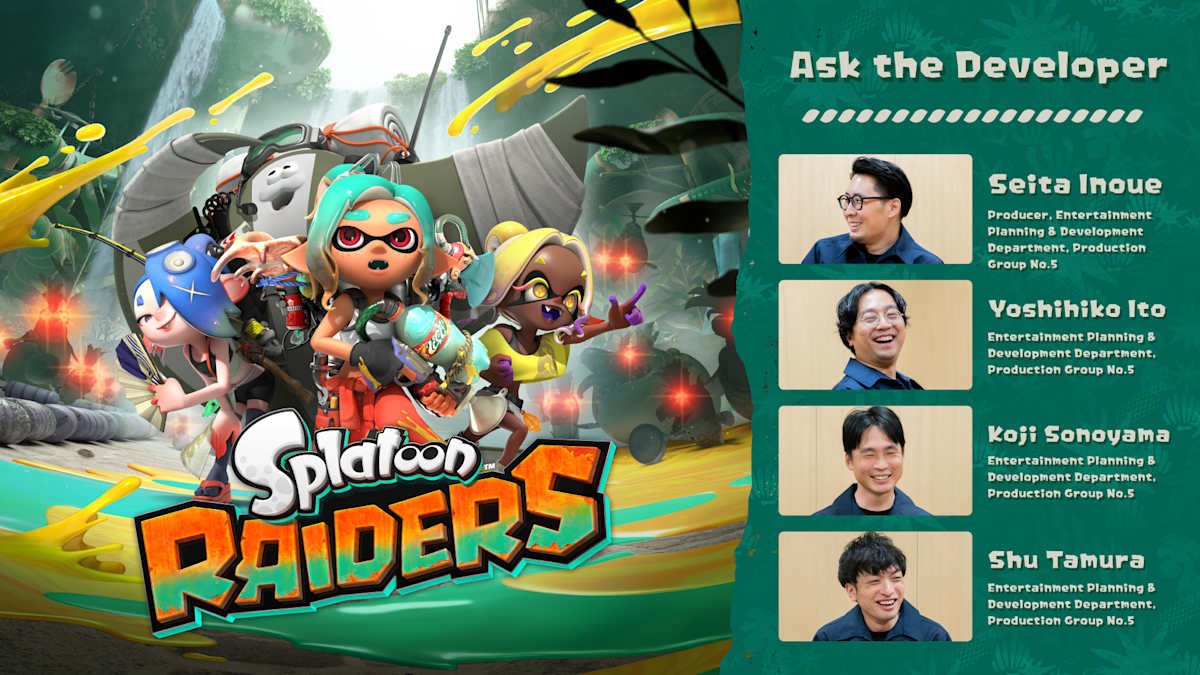
Nintendo's first developer interview for Splatoon Raiders explains a much bigger change than a new set of missions. After more than a decade of building Splatoon around competitive battles, the team wanted to see whether the series' movement, ink and Salmonid combat could carry a game designed mainly for one player.
Why Nintendo chose a spin-off
Producer Seita Inoue said the team had spent 11 years developing and updating three main Splatoon games. Instead of moving directly to Splatoon 4, the developers wanted to turn the series' non-competitive ideas into a full entry point of their own.
That distinction matters. Nintendo is not presenting Raiders as the replacement for competitive Splatoon. Inoue said competitive development will continue, which is why this project became a spin-off rather than the fourth numbered game.
The first prototype did not feel like Splatoon
Work began as updates for Splatoon 3 were winding down. The team experimented with adapting Salmon Run into a single-player game and used Nintendo Switch 2's extra performance to put larger groups of Salmonids on screen.
The early version leaned toward base defense. Players placed traps, built a position and watched enemies run into it. Director Yoshihiko Ito said the idea worked mechanically, but it made the player too passive. The team felt it lost the fast rhythm created by shooting ink, swimming, changing form and moving constantly.
That failed prototype became the turning point. The developers removed the fortress focus and built the game around direct action.
Gadgets became the new answer
Raiders lets the player combine a weapon with two gadgets. Those gadgets can add a charge, a high jump, hovering movement or other ways to control a crowd. Cooldowns encourage players to rotate between all three tools instead of waiting for one strong attack to recharge.
The goal is what the team calls pleasant busyness: the player sees a problem, changes tools and reacts almost immediately. Parts collected from defeated Salmonids can also strengthen or alter gadgets, giving the single-player loop a progression system that competitive matches do not need.
The design problem behind all that action
More enemies and more tools can easily make a fight unreadable. Nintendo's art and sound leads said clarity became a major production concern. The team adjusted sound cues to communicate attacks and damage, while mission intensity increases gradually so players learn the systems before the busiest encounters.
That is an important comparison with Salmon Run. A four-player team can split threats and objectives. A solo player has to read the whole field, so Raiders must supply both the power and the information that teammates normally provide.
A pre-release review supports the design, with a caveat
GameSpot's Steve Watts published his review on July 21, two days before the announced launch. He praised the gadget customization and crowded battles, but also found that some familiar weapons were less useful in this new format.
The more important qualification concerned progression. Watts reported reaching maximum level with favored Tanks and Showstoppers while alternatives remained underdeveloped. Switching could leave him feeling underpowered as stages grew harder, while staying with mastered equipment wasted further experience. That criticism complicates the idea that a larger set of tools necessarily encourages experimentation.
Our reading is that Raiders' design has two separate tests: whether the gadgets create interesting actions, and whether progression makes changing between them practical. A positive answer to the first does not settle the second.
These are GameSpot's observations and our interpretation, not GG Bulletin playtesting. The review disclosed roughly 15 hours of play plus an hour of multiplayer using publisher-provided review code; its limited pre-release multiplayer experience is not evidence of post-launch service reliability.
Timeline and confirmed data
The first interview was published July 21, 2026, two days before the July 23 launch. Nintendo lists Splatoon Raiders as a Nintendo Switch 2 exclusive at $49.99. The development account covers the period after Splatoon 3 updates began winding down, the discarded trap prototype and the later shift toward gadgets.
Questions the record does not settle
Nintendo has not said when the next competitive Splatoon project will arrive or how Raiders will affect that schedule. The interview also does not establish a long-term update plan for the spin-off. Players still need post-launch support details before treating Raiders as an ongoing platform rather than a self-contained release.
Bottom line
Splatoon Raiders changed course because its first idea was too passive. Nintendo kept the Salmon Run foundation, then replaced trap-heavy defense with weapons, gadgets and constant movement. The result is less a retreat from competitive Splatoon than a test of whether the series can support a second, solo-focused path.