
A different protagonist changes the design problem
Resonance: A Plague Tale Legacy’s August 20 Xbox Wire interview gives concrete examples of the move toward action-adventure. The post is by Focus’s Alexia l’Equilbec and presents Asobo’s account of its own design, not an independent verdict.
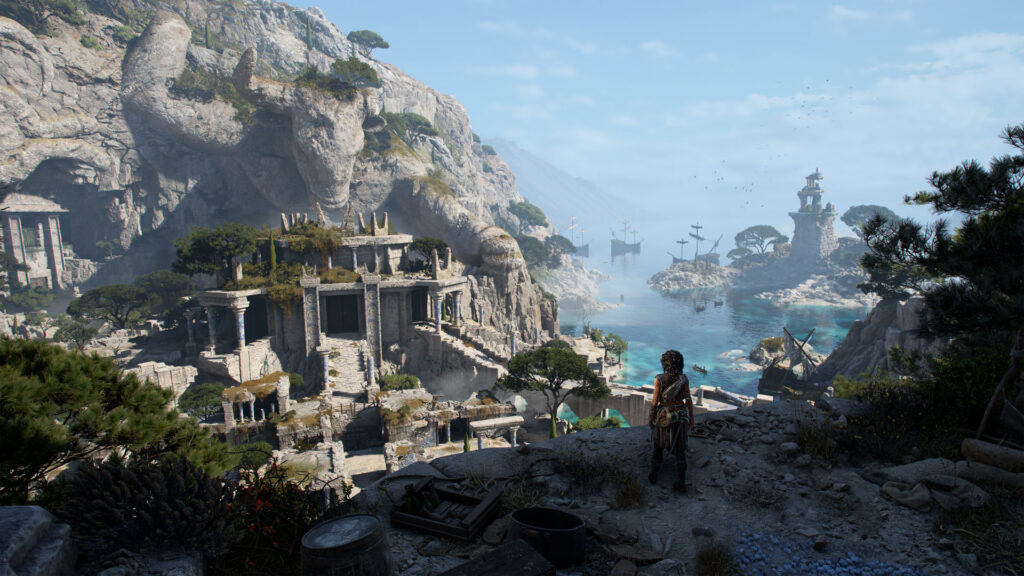
Asobo describes Sophia as a better fit for more active combat than the earlier protagonist. Level designer Vincent Trinel contrasts designated climbing points in the previous games with freer jumping and climbing here, supported by a grappling hook. That changes the work of building a level: instead of identifying the few places a player can climb, the team must consider where that greater mobility needs boundaries.
The interview also describes a Minoan-inspired setting and a changed manifestation of the Macula. Its closing release notice gives August 27 for Xbox Series X|S and Xbox on PC, with Game Pass and Xbox Play Anywhere. Those are the historical announcement’s terms, not a current subscription-catalog check.
Our reading: freedom needs readable limits
The useful comparison is between permission and possibility. A marked climbing point says “this action works here.” A freer movement system asks players to judge a surface or route for themselves. That can make exploration more expressive, but it also makes consistency important.
If a player reasonably expects to reach a ledge, an unexplained barrier can feel more frustrating than a clearly constrained route. We would therefore judge the new movement through repeated situations: whether similar surfaces behave similarly, whether hazards can be anticipated, and whether a mistaken jump teaches something understandable.
These are our evaluation criteria, not observations from playing Resonance.
An action shift does not settle the tone
The developers describe continuity in themes and visual identity even while changing the style of play. We would not infer from the increased mobility alone that the story has become carefree, or from the franchise name that every familiar stealth convention remains.
A more capable protagonist can change the source of tension. Instead of asking whether a character is physically able to escape, an encounter might ask which route is worth the risk. That is one possible consequence of the stated design direction, not a scene we claim exists in the game.
A correction, not a new launch report
Our original article said the source did not explain the changed mechanics or exploration. The full interview does. This revised account removes that claim and an unrelated, unverified pre-release leak dependency.
For a returning player, the meaningful point is the changed relationship between movement and level design. For a new reader, the source offers a clear account of developer intent—but deciding whether it works across the finished game requires hands-on criticism. We do not provide that verdict here.